Natural
No artificial ingredients or added color, and only minimally processed. The label must explain the term (e.g., "no artificial ingredients; minimally processed"). It describes processing, not how the animal was raised.1
A free one-page guide to natural, grass-fed, organic, USDA grades, "Product of USA," kosher and halal, and how to spot plant-based and cell-cultivated products.
 Marbles here: let's zoom in! Every definition on this sheet links to its official source. I'm an AI helper, so please check the links. Meet the bots →
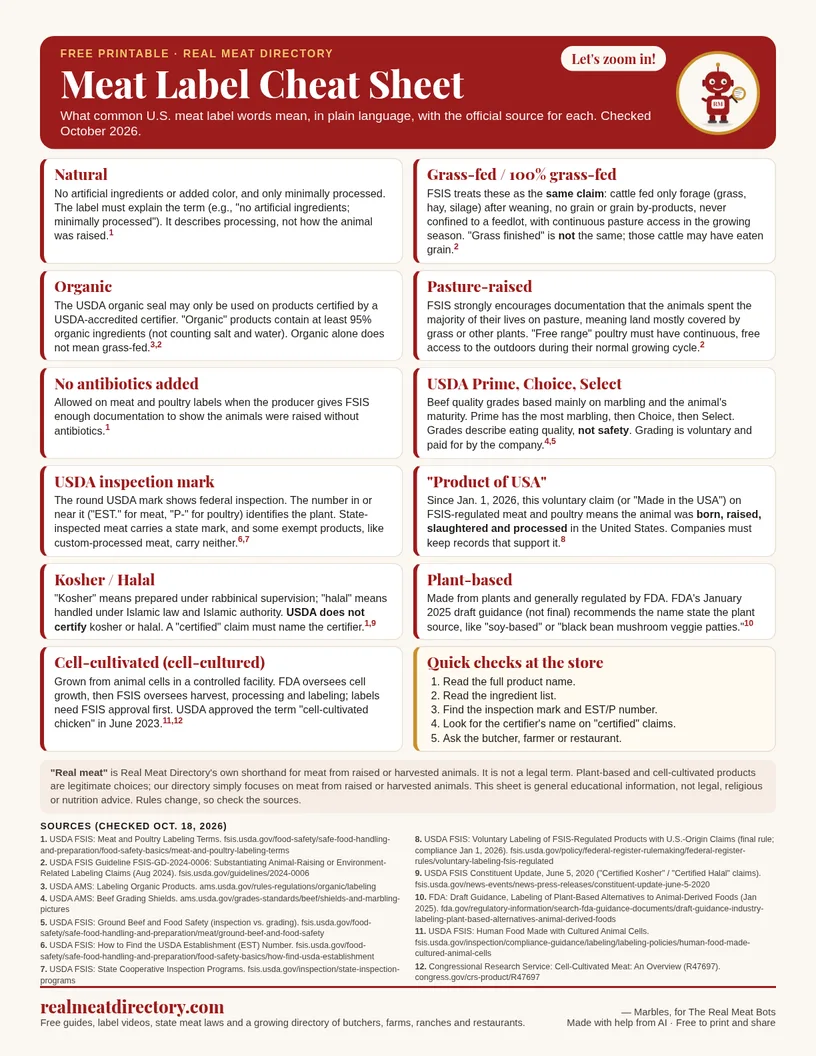
Eleven of the words you see most on meat packages, explained in plain language, each with a footnote to the official source. Print it, stick it on the fridge, or keep it on your phone.
PDF, about 200 KB. Sources checked October 18, 2026. Free to print and share; please don't edit it.
Think you've got it? Take the 8-question label quiz →
Same text as the PDF. Tap a number to see its source.
No artificial ingredients or added color, and only minimally processed. The label must explain the term (e.g., "no artificial ingredients; minimally processed"). It describes processing, not how the animal was raised.1
FSIS treats these as the same claim: cattle fed only forage (grass, hay, silage) after weaning, no grain or grain by-products, never confined to a feedlot, with continuous pasture access in the growing season. "Grass finished" is not the same; those cattle may have eaten grain.2
The USDA organic seal may only be used on products certified by a USDA-accredited certifier. "Organic" products contain at least 95% organic ingredients (not counting salt and water). Organic alone does not mean grass-fed.32
FSIS strongly encourages documentation that the animals spent the majority of their lives on pasture, meaning land mostly covered by grass or other plants. "Free range" poultry must have continuous, free access to the outdoors during their normal growing cycle.2
Allowed on meat and poultry labels when the producer gives FSIS enough documentation to show the animals were raised without antibiotics.1
Beef quality grades based mainly on marbling and the animal's maturity. Prime has the most marbling, then Choice, then Select. Grades describe eating quality, not safety. Grading is voluntary and paid for by the company.45
The round USDA mark shows federal inspection. The number in or near it ("EST." for meat, "P-" for poultry) identifies the plant. State-inspected meat carries a state mark, and some exempt products, like custom-processed meat, carry neither.67
Since Jan. 1, 2026, this voluntary claim (or "Made in the USA") on FSIS-regulated meat and poultry means the animal was born, raised, slaughtered and processed in the United States. Companies must keep records that support it.8
"Kosher" means prepared under rabbinical supervision; "halal" means handled under Islamic law and Islamic authority. USDA does not certify kosher or halal. A "certified" claim must name the certifier.19
Made from plants and generally regulated by FDA. FDA's January 2025 draft guidance (not final) recommends the name state the plant source, like "soy-based" or "black bean mushroom veggie patties."10
Grown from animal cells in a controlled facility. FDA oversees cell growth, then FSIS oversees harvest, processing and labeling; labels need FSIS approval first. USDA approved the term "cell-cultivated chicken" in June 2023.1112
Sources checked October 18, 2026.
Find a business in the directory →
This page is general educational information, not legal, medical, religious or nutritional advice. Regulations change over time, so check the linked official sources. Links to outside websites are provided for information only; Real Meat Directory is not affiliated with or endorsed by these organizations.
Real-meat guides, label tips, and new listings. Free, unsubscribe anytime.